

Who We Are
The International Committee on Germany’s Debt to Greece focuses on informing the public about Germany’s debt to Greece from World War II, as well as pressing Germany to repay its debt, which exceeds one trillion euros. The Committee’s members, active for many years, continue their work with determination and integrity. We conduct research and public outreach, building alliances with organizations and individuals around the world who share our commitment to truth, justice, and accountability.
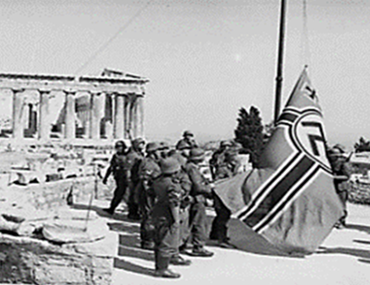
Germans raise the Swastika flag at the Acropolis
Historical Background
Between 1941 and 1944, Greece was invaded by the forces of Nazi Germany, devastated, and plundered during an occupation that inflicted incalculable human cost through deaths from starvation and mass executions of civilians (the so-called “reprisals”), as well as the near-total annihilation of its Jewish communities through deportations to concentration camps. At the same time, the Greek economy was forced to finance the presence and activities of the occupiers themselves. For this crime, there has been neither justice nor punishment.
This website documents and analyzes the historical and economic basis of Greece’s still-unfulfilled claims from that period—namely the Forced Loan, the reparations for the destruction of infrastructure, compensation for the atrocities committed against defenseless civilians, and the recovery of stolen cultural treasures—explaining why these issues remain urgent in politics, diplomacy, and collective memory today.
After WWII, at the 1946 Paris Peace Conference, Greece demanded that Germany and Italy pay for the damages and losses it had suffered. Greece’s claims against Germany and Italy are set out in four thematic categories:
- Return of the sums forcibly extracted from the Greek economy—either to cover the maintenance of the occupying forces or in the form of loans. It concerns Occupation Loans.
- Restoration of the damage Greece suffered to its infrastructure and productive capital. It concerns War Reparations.
- Compensation to victims and their heirs for the destruction of private property, executions of civilians, and deaths from famine attributable to the occupation forces. It concerns the Compensation to Victims of the Occupation.
- Return of ancient statues, books, paintings, and other cultural wealth stolen from Greece’s museums and libraries, and illegally exported abroad. It concerns the Repatriation of Stolen Cultural Treasures.
Italy agreed to satisfy Greece’s claims to a large extent. By contrast, Germany— which caused the greatest destruction and benefited most from the economic plunder of Greece—has systematically refused to repay its obligations, even though eighty years have passed since then. Germany’s refusal violates every principle of ethics and justice, as well as the international law, and sets a harmful precedent in interstate relations. Our struggle is not only for the application of law in Greece, but also for the restoration of dignity and justice in Europe.
Quick Links
Stay Informed
Receive updates on research, documentation, and international advocacy on efforts regarding Germany’s debt to Greece.
By subscribing, you agree to our Privacy Policy.